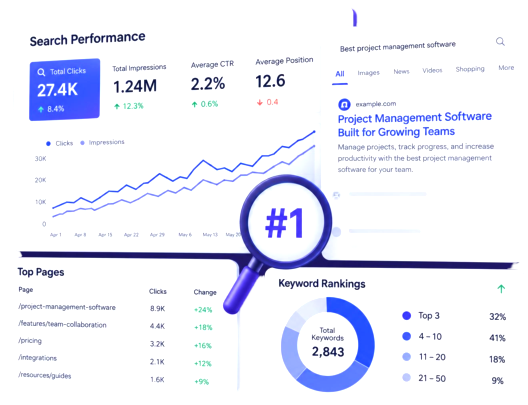

Improve Organic Visibility on the Pages That Drive Business
We strengthen technical SEO, search intent alignment, site structure, and page relevance so priority pages can compete for searches connected to your products, services, and customer demand.
Map valuable search demand to the pages best suited to rank, answer the query, and support a business action.
Resolve crawl, indexation, canonical, rendering, and redirect issues that can weaken organic visibility.
Align page structure, copy, metadata, and topical relevance with the searches each page is expected to compete for.
Strengthen page relationships so search engines can understand site hierarchy and priority content receives better internal support.
Protect rankings, URLs, internal links, and indexation when the website, platform, content, or structure changes.
More keywords, pages, and content will not improve organic performance when the main SEO constraint remains unresolved.
Focus on search terms connected to genuine customer demand, relevant offers, and meaningful business actions.
Give each important search intent a clear destination instead of allowing several pages to compete for the same query.
Determine whether performance is being held back by technical SEO, page relevance, site structure, competition, or authority.
Decide whether the next step should be optimisation, consolidation, new content, technical fixes, or protection of existing rankings.
Good SEO prioritises the work with the strongest reason to exist.
Share your website, rankings, reports, or current SEO activity. We will review where effort is being spent and where stronger opportunities exist.
Build a clear connection between search demand, search intent, business priorities, and the pages expected to rank.
Assess technical issues that affect crawling, indexation, page signals, and search engine access.
Implement the approved theme approach and the custom storefront functionality the store requires.
Configure what Shopify cannot handle alone, without creating unnecessary app dependency.
Prepare and validate the move so store data, URLs and critical operations continue correctly.
Validate the live store and continue improving it as requirements change.
Industry / SEO Project Type
The final design gave our product a level of clarity we were struggling to achieve internally. Complex information became much easier to navigate, and the design system gave our development team a much stronger foundation to build from.
Head of Product, Altura Systems
You may come to us with a new store, a migration, or a SEO setup that no longer supports the business cleanly. We review products, operations, integrations, markets and checkout needs before deciding whether standard SEO, or another approach makes sense.
Most Shopify problems are decided before a theme is installed. We define the product model, collection logic, navigation and content structure first. Metafields and metaobjects are planned at this stage so the team can manage the store later without a developer.
We check what Shopify already does, then compare an app against custom development on cost, dependency and long-term maintenance. Every app added to a store carries a monthly fee, a script and a point of failure. We only add one when it earns its place.
We implement the approved theme approach, custom sections and templates, then connect the systems the store depends on. Integrations to ERP, inventory, fulfilment and CRM are built as data flows, so information moves in both directions correctly.
We test the full buying journey, checkout, discounts, shipping logic and fulfilment, across devices and markets. Admin workflows are tested too, because a store the team cannot operate is not finished, however well it converts.
Launches are staged and reversible, with redirects, analytics and integrations verified before traffic moves. After launch we continue development where change adds value, rather than handing over and disappearing.



URL changes, deleted pages, new navigation, and content restructuring can affect existing search performance. SEO planning helps preserve valuable signals before the new site goes live.
Recommendations are based on the actual search constraint, not a fixed checklist of monthly SEO tasks.
Current pages are evaluated first so useful content is improved and unnecessary overlap is reduced.
Technical SEO, content, UX, development, and site structure are considered together when they affect organic performance.
Rankings matter, but qualified organic traffic, priority-page performance, enquiries, and conversions provide the wider picture.
Yes. We can review current keyword targeting, rankings, technical SEO, content, backlinks, Search Console data, and reporting to see where priorities may need to change.
No. New content should address a genuine search opportunity. Existing pages may deliver better value through optimisation, consolidation, or stronger internal linking.
Yes. Technical SEO can include crawlability, indexation, canonicalisation, redirects, rendering, sitemaps, duplicate URLs, and other issues affecting search engine access.
Yes. We can plan URL mapping, redirects, page preservation, internal links, metadata, indexation, launch checks, and post-launch SEO validation.
Keyword targeting is based on search intent, business relevance, search demand, competition, SERP patterns, and whether the website has the right page to compete.
We monitor relevant rankings, organic visibility, priority landing pages, organic traffic, enquiries, conversions, and Search Console performance.
No. No SEO provider controls Google's rankings. We focus on evidence-based SEO decisions, proper implementation, and measurable improvements within the factors we can influence.
Let’s turn your vision into a digital solution that healthier business grow attract more customers and create lasting impact
We build digital brands that inspire trust, generate leads, and accelerate business growth through innovative web, marketing, and technology solutions.
© Copyright 2026 by Growim