
E-COMMERCE DEVELOPMENT
Your Store Is Only as Strong as the Commerce System Behind It
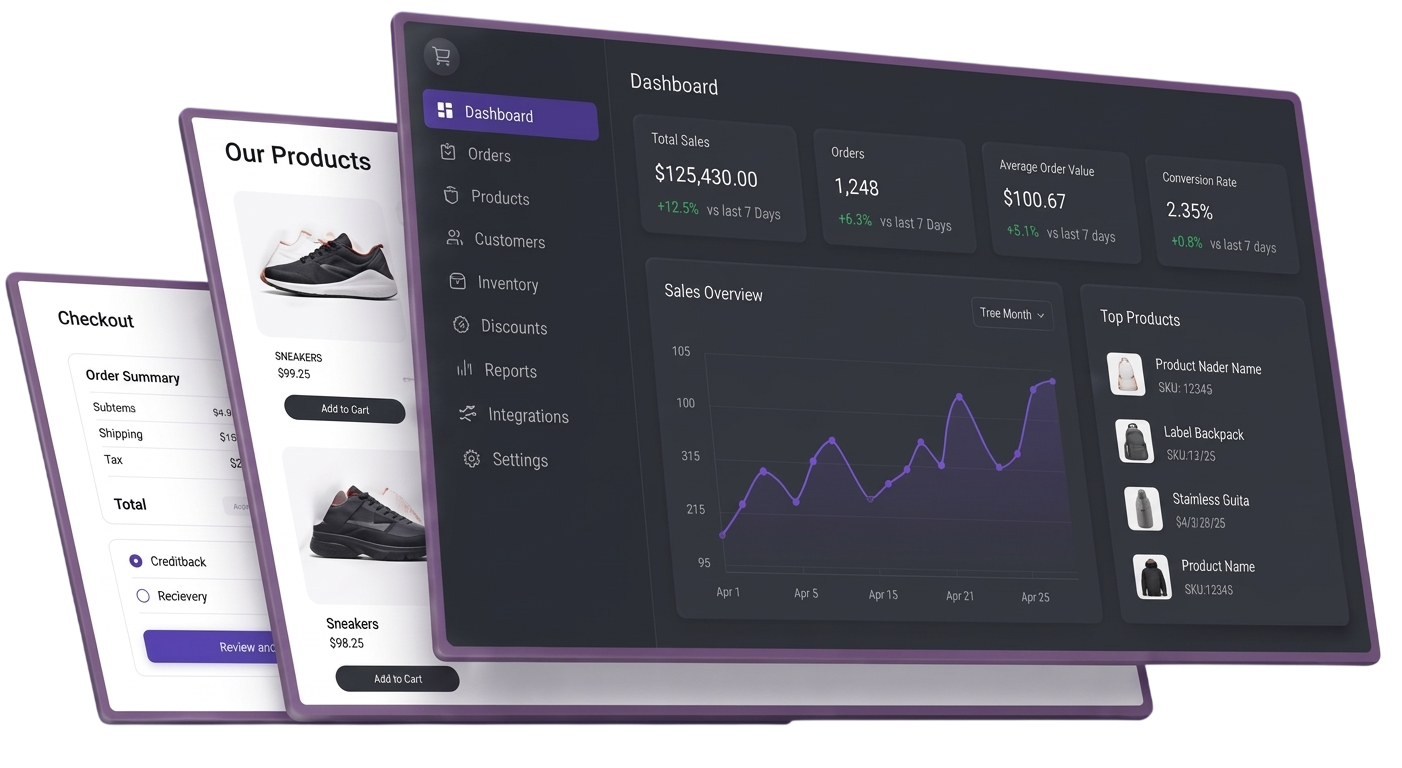
We plan and develop the buying journey and the systems behind it, from catalogue and checkout to inventory, fulfilment, and integrations. For live stores, we diagnose the constraint before deciding whether to improve, integrate, migrate, or rebuild.
Define how products need to behave before shaping the catalogue around them.
Clarify who can buy, what they pay, and whether different buyers need different purchasing terms.
Work out how checkout should handle payment, tax, delivery, validation, and other conditions of the sale.
Decide what should happen after purchase so orders can move cleanly from payment to fulfilment.
Identify where product, customer, stock, order, and financial data needs to move.
Customers may be struggling with discovery, mobile purchasing, checkout rules, payment failures, or unnecessary steps.
Manual stock updates, order handling, fulfilment work, and difficult administration can limit the business behind the storefront.
Performance problems, plugin conflicts, technical debt, or rigid platform rules may make routine changes increasingly difficult.
Poor synchronisation between the store, inventory, ERP, CRM, accounting, or fulfilment systems can create errors across the operation.
We trace the cause across the storefront, platform, data, and connected systems before recommending a targeted improvement, integration, migration, or rebuild.
Checkout drop-offs, stock mismatches, slow catalogues, fragile integrations, or too much manual work often have different root causes. We will help identify what actually needs changing.
Develop product discovery and buying interfaces around the way the catalogue actually needs to be sold.
Implement purchasing rules that account for payment methods, pricing, tax, validation, and transaction states.
Connect what customers buy with how the business receives, routes, fulfils, changes, and returns orders.
Connect the store with the systems responsible for stock, customers, finance, fulfilment, and other sales channels.
Support commerce models where pricing, purchasing rules, markets, or buyer relationships vary.
Move a live commerce operation while accounting for data, URLs, integrations, trading continuity, and what should not be carried forward.
Explore campaign work focused on attracting the right audience, improving conversion efficiency, and turning media spend into stronger commercial results.
Industry / Commerce Model
Industry / Commerce Challenge
“Insert a verified client quote about an e-commerce project, commerce integration, migration, operational improvement, or store performance.”
Role, Company
We start with how products are organised, who buys them, how pricing works, how payment is taken, and what must happen after an order is placed. For live stores, we also trace current platform limits, manual work, data flows, and system dependencies before defining the scope.
Define platform fit, commerce rules, integrations, and launch priorities.
Build the customer-facing experience and required commerce behaviour.
Connect product, stock, customer, order, and operational data.
Test complete purchase, payment, inventory, and fulfilment scenarios.
Release carefully, monitor trading, and improve where evidence supports it.

Catalogue complexity, buyer types, markets, operational systems, internal ownership, and required custom logic determine the technology choice. The platform follows the commerce model, not the other way around.


Reservations, warehouse updates, cancellations, and simultaneous orders need clear inventory rules so customers are not buying stock that does not exist.
Successful payments are only one path. Failed attempts, retries, duplicate events, refunds, and reconciliation need defined behaviour too.
Address updates, cancellations, partial fulfilment, returns, and refunds should not leave customers or internal teams guessing what happens next.
When an ERP, warehouse, marketplace, or payment service stops responding, the commerce operation needs controlled retries and a clear way to recover.
That depends on how you sell. We look at catalogue complexity, buyer types, pricing, markets, integrations, administration needs, and required custom logic before recommending a platform.
We prioritise what is required to take and fulfil real orders reliably. Lower-value automation, advanced merchandising, additional channels, or more complex features can wait when they do not need to be part of launch.
We first identify whether the problem comes from configuration, custom code, data, integrations, performance, or a genuine platform limitation. If the existing store can be improved cleanly, a rebuild is unnecessary.
Yes. The important question is not only whether systems can connect, but which system should own each type of data and how updates should move between them.
We plan around products, customers, orders, URLs, redirects, integrations, data mapping, and cutover. Existing functionality is assessed before migration so important trading behaviour is not lost accidentally.
Yes, where the chosen architecture supports the requirements. This can include buyer-specific pricing, payment terms, currencies, markets, recurring purchases, multiple warehouses, and different fulfilment rules.
That is considered during development. Routine product, pricing, promotion, order, and content work should stay practical for the people running the commerce operation without unnecessary developer dependency.
Whether you’re preparing to launch, fixing an existing store, or planning improvements, we’ll help you identify the right next steps and create a smoother shopping experience for your customers.
Let’s turn your vision into a digital solution that healthier business grow attract more customers and create lasting impact
We build digital brands that inspire trust, generate leads, and accelerate business growth through innovative web, marketing, and technology solutions.
© Copyright 2026 by Growim